The Story of Darbyshire Pottery
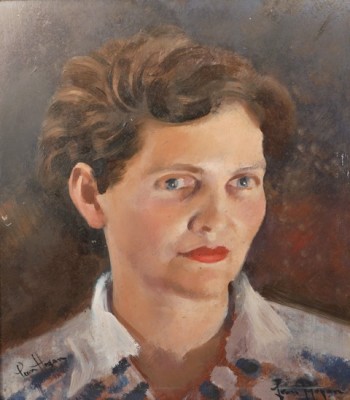
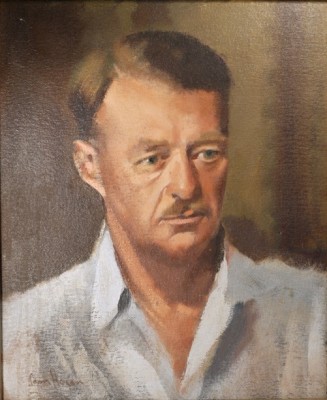
Jean Katie Elliott (1910–1996) and Alfred William ‘Bill’ Leete Darbyshire (1903-1964)
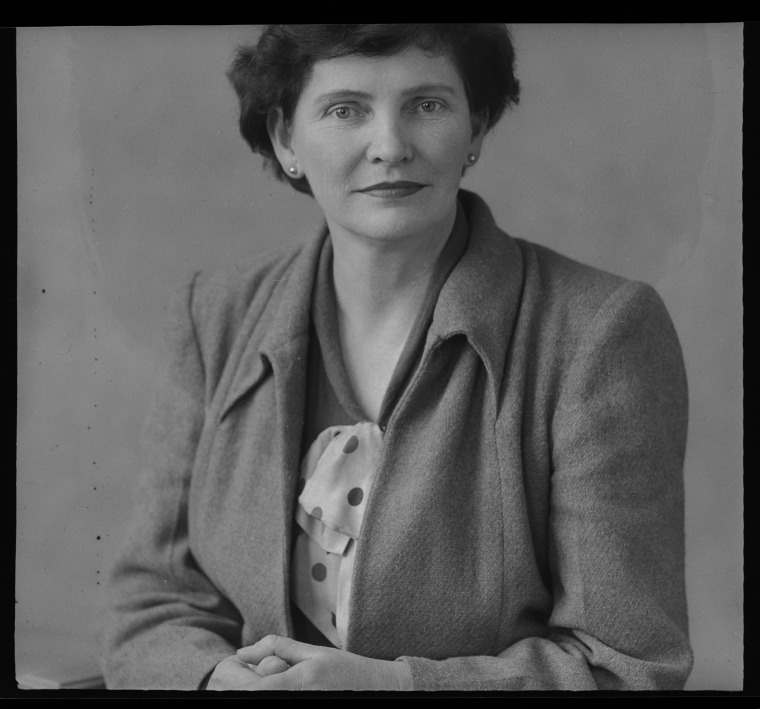
Jean Katie Elliott was born on 26 September 1910 in Kalgoorlie, Western Australia. Her father, Charles George Elliott was a mine manager and Goldfields MLC, and her mother, Catherine ‘Katie’ Reid received a MBE for services to Infant and Maternal Welfare. She had a sister Myra and a brother Stirling. Jean attended Eastern Goldfields High School and later studied Business. She was also a skilled violinist.
She married Edward ‘Robert’ Shaw in 1931 and they had two children together: Robert (1931) and Stirling (1933). Edwards’s parents lived at Lake View Mine and after studying at the Kalgoorlie School of Mines Robert worked as a mechanical engineer. They lived at 63 Lewis St, Kalgoorlie; before moving, in 1936, to 150 Joel Terrace, East Perth (Maylands).
In 1938 Jean studied studio pottery under the instruction of Reg Landells and his wife Flora Landells, who was art mistress at MLC. Flora was well-known as a china painter, and for her hand built, and wheel thrown pottery. For her own pottery, Jean used blue clay dug from her own backyard, which adjoined the Swan River at Maylands. Some of her hand thrown pieces from this time were signed ‘Elliott’.
From 1939-1941 Jean was Assistant Superintendent of Red Cross Transport Officers and also owned and managed a florist shop in Hay St, West Perth for four years.
The Shaw’s became friends with Mollie and Bill Darbyshire who lived nearby at 129 Joel Terrace. In 1940 Bill joined the AIF but was discharged 5 months later- deemed medically unfit with ‘varicose veins’.
During this time Jean and Bill began an affair. Jeans husband Robert discovered letters between Jean and Bill and showed them to Mollie, who was devastated, as she considered Jean a good friend. Jean and Bill filed for divorce, which was granted to both couples on the 5 Dec 1940.
Jean (30) then married Alfred William ‘Bill’ Leete Darbyshire (38) in July 1941. Bill Darbyshire had emigrated to WA from Liverpool in 1922. He came first in Federal Accountancy exams, and in 1929 was offered a job with Vacuum Oil Co. Perth, where he worked for the next 12 years, ending up as chief clerk.
Bill first married in 1928 and had two children with Mollie Tolland; a daughter Caroline (1930) and son Tony (1933), who was the same age as Jeans son, Stirling.
There were many sides to Bill: he played and refereed ‘A’ grade Rugby and was a founding member of the Rugby Union Council of WA but was also a keen amateur actor; a member of the Perth Repertory Theatre, from 1933-1939 and leader of a literary writers group, part of the Workers Art Club (1936). He was described by Phyllis Ophel (née Hartnett) as “one of us but not of us” meaning a left-winger, a fellow traveller but not a member of the Communist Party of Australia. (Dylan Hyde).
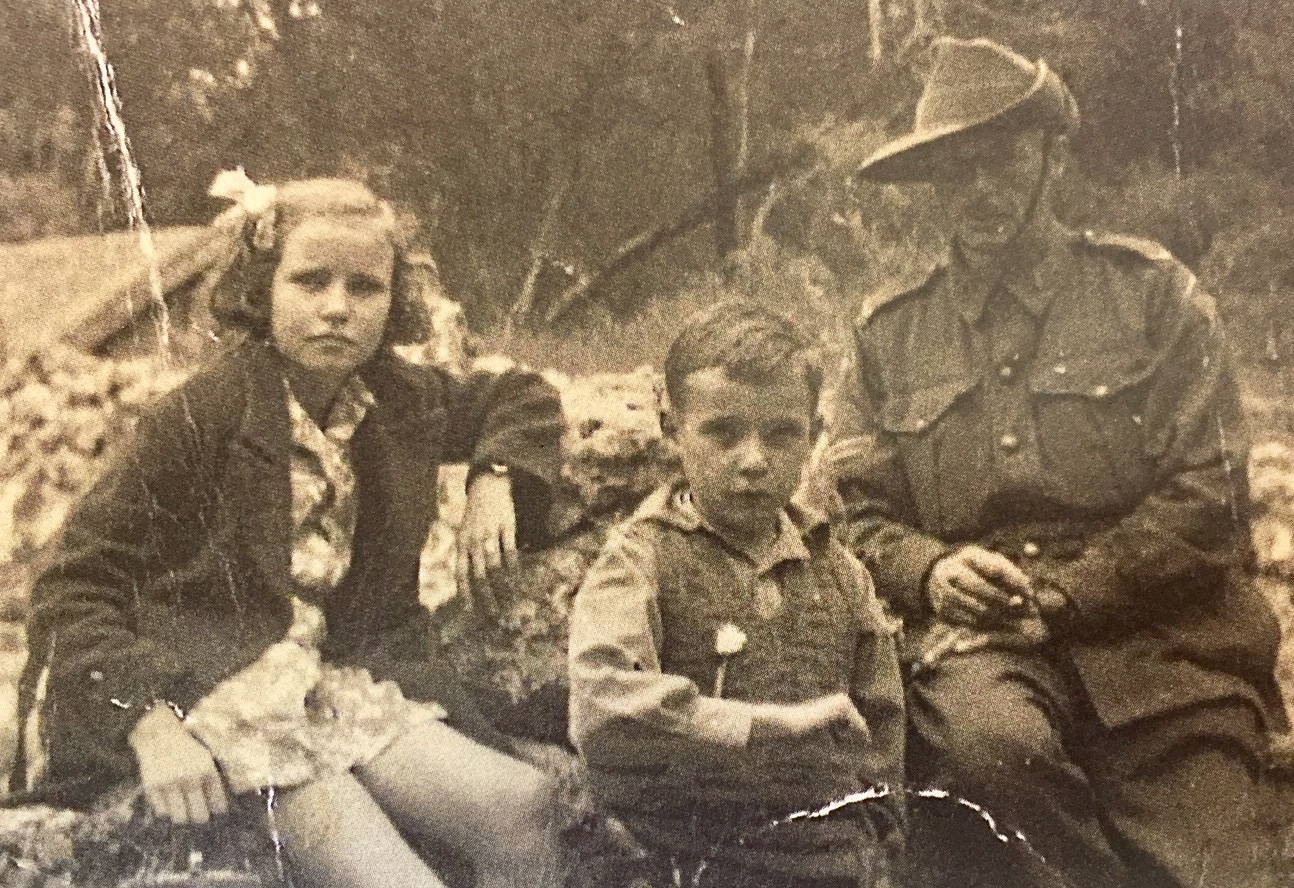
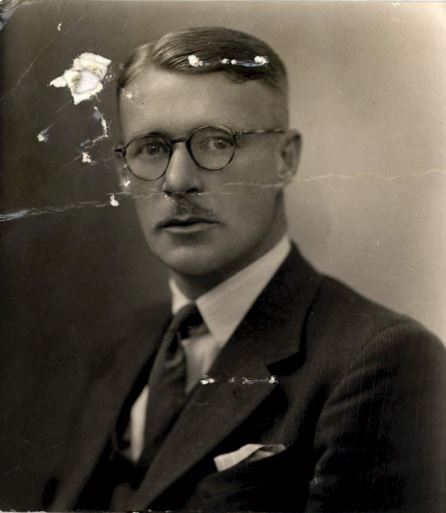
Photos left: Carol, Tony and Bill Darbyshire AIF c. 1940, and right: Bill Darbyshire, RAAF, 1941 (Defence Force records NAA).
In October 1941, when he was 38, Bill completed an Administration Officers course and joined the RAAF as a Paymaster- serving at Northam Camp and Pearce Air Base, in WA. He also served for two months in the South West Pacific between 6 July – 23 Sept 1942, and in the Northern Territory ( 1945).
“He has ability, experience, good approach and organising ability, but like ‘the cow that gives a bucket of milk, then kicks it over’, does not inspire confidence. Becomes difficult after a few drinks and as a result, destroys the confidence of his fellows- generally displays the impression of being radical and erratic.” (Defence Force records NAA)
Despite this damming assessment of his character Bill finished the war (4 Jan 1946) with the rank of Squadron Leader. Both he and Jean were not religious.
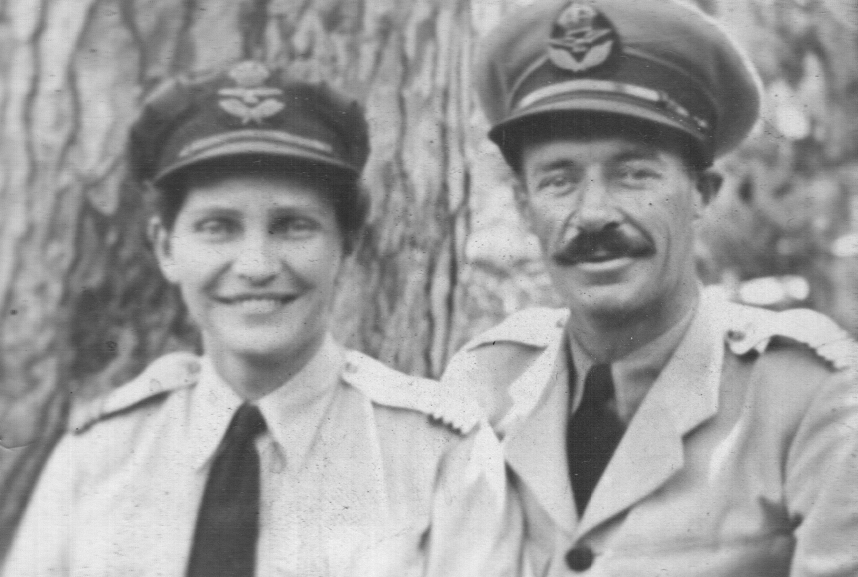
Bill and Jean first lived at 1266 Hay St, Perth, the address given when Jean enrolled on the 23 Feb 1942 as a Trainee Officer in the School of Administration‚ Women’s Auxiliary Australian Airforce (WAAAF) –and went to Melbourne, Victoria. She rose to commissioned rank of Flight Officer. She served in Geraldton, Pearce, Perth and at General MacArthur’s Australian Headquarters, in Brisbane. (Defence Force records NAA)
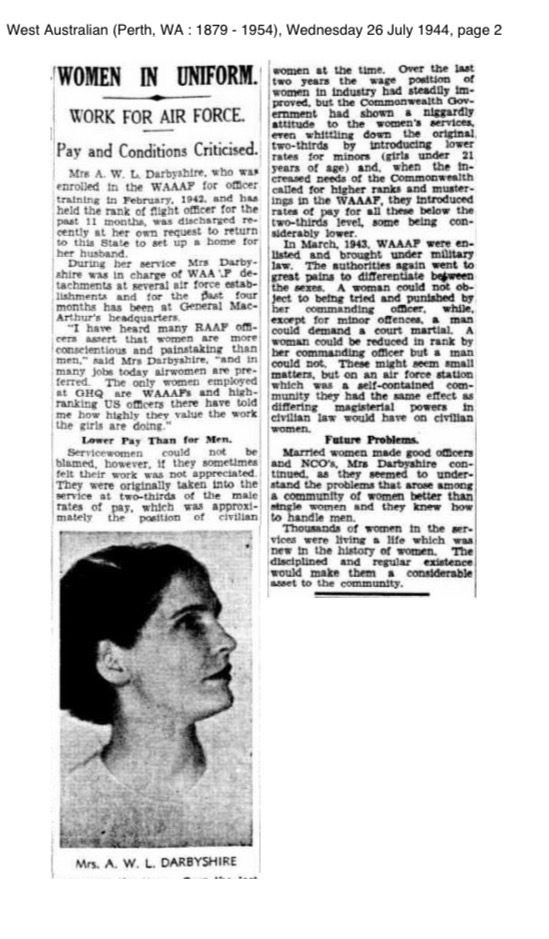
In 1944 she returned from Melbourne to Perth by rail to work at Pearce Air Base with Bill. She was described in a report as: “temperate, sufficiently self-assured, doesn’t back down too easily but rather over-confident, well balanced, cool headed, somewhat self-centred but does co-operate”.
As Flight Lieutenant in charge of WAAAF detachments during WW11, she was interviewed by the West Australian (26 Jul 1944 p 2), on her view of women in the WAAAF. She complained that women’s pay was 2/3rds that of men.
After being discharged on 1 July 1944 Jean participated in a short course in sculpting/modelling with the Repatriation Dept. Perth and shared a studio with other ex-service personnel.
In April 1948 in a tin shed at 108 Wellington St, Perth, Jean and Bill started Darbyshire Ware Pottery with a staff of 3. In 1949 they moved the business to 710 Wellington St, where it grew quickly and they soon employed 22 people, mostly women.
“Wanted: ARTISTIC intelligent Woman for responsible work, Darbyshire Ware Pottery, 710 Wellington-st.” (West Australian, 16 Sept 1949, p38)
Jean was the Production manager and Bill ran the business.
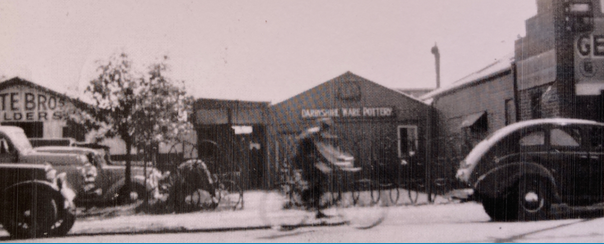
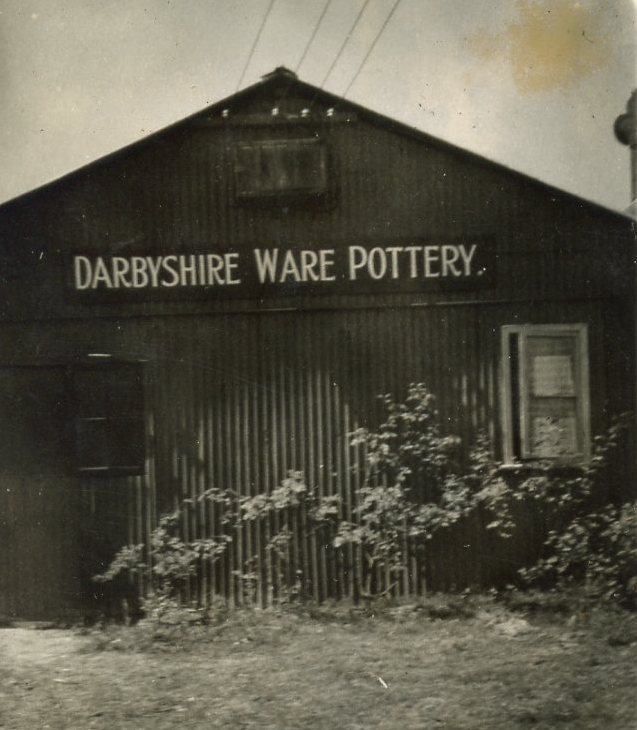
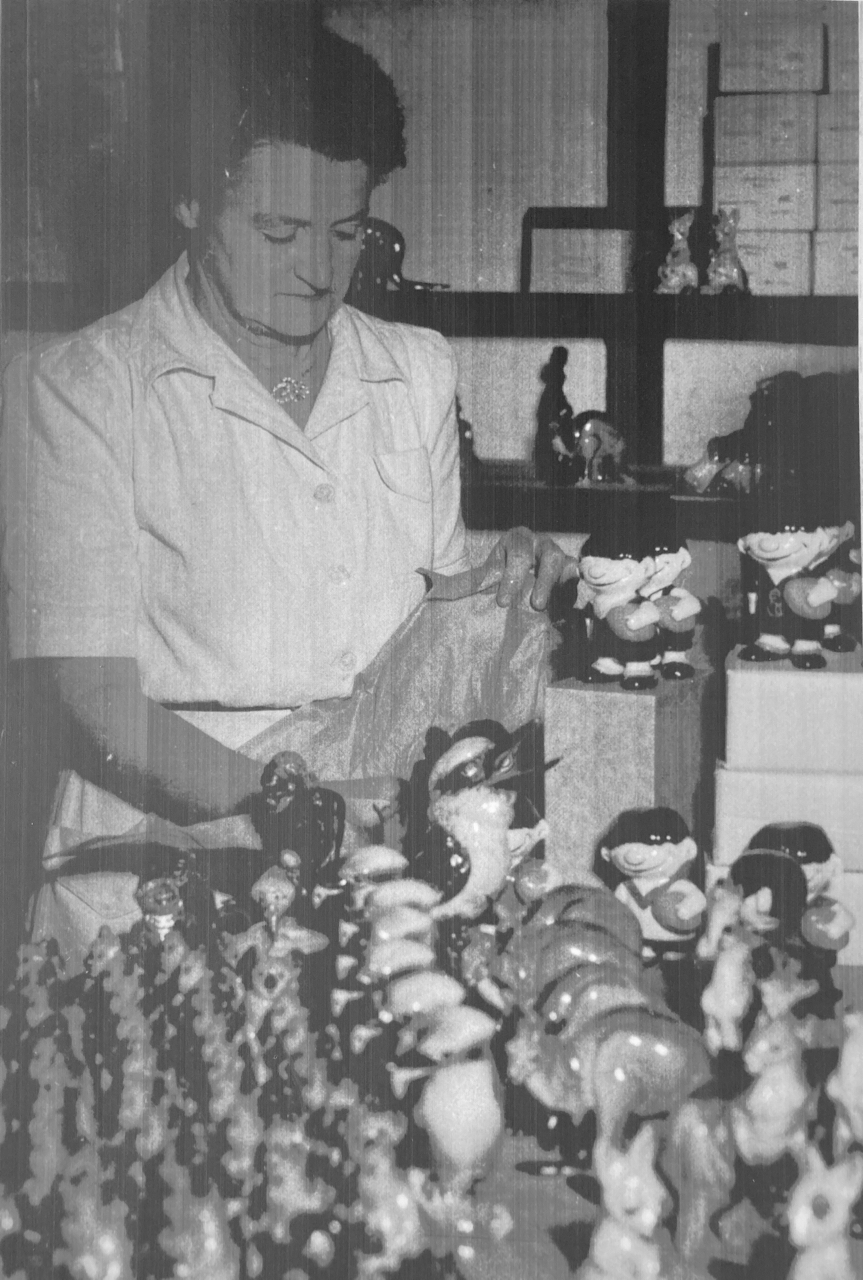
By 1950 Jean had perfected the slip cast method, and was producing in excess of 4,000 pottery animals a week, which were selling to the Eastern States markets as well as locally. Jean designed and modeled all the animals herself, and worked with mould maker Mr Gough (formerly of Royal Doulton) to make plaster moulds. Mr Gough also contributed a secret glaze, the recipe of which, he guarded closely, even from Jean. Other competitors such as Calyx, copied Darbyshire wares but could not copy the unique glaze, which differentiates Darbyshire pieces.
In August 1951‚ and in late 1953 Jean visited ‘Tokio, Osaka, Kyoto and Nagoya’ in Japan to study Ceramic production techniques, including to the Noritake factory. She took some of her products as gifts. It was said that these were later copied by the Japanese ( badly) and imported in 1956.
In Dec 1952 Darbyshire Pottery Pty. Ltd. built a new factory on three acres of land at 17 Government Rd (soon after renamed Odin Road), Osborne Park.
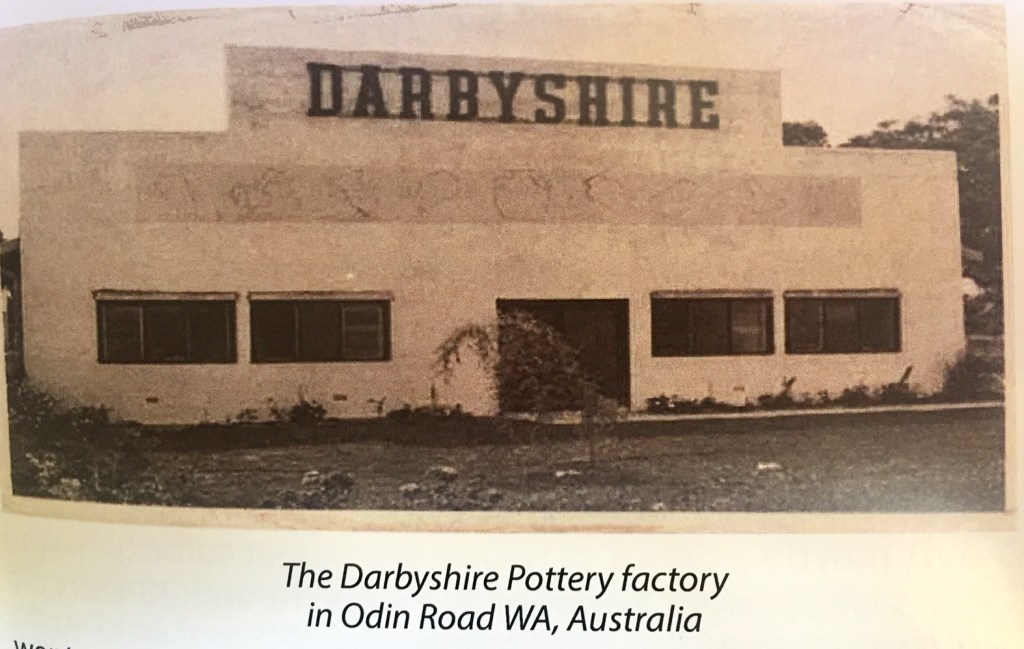
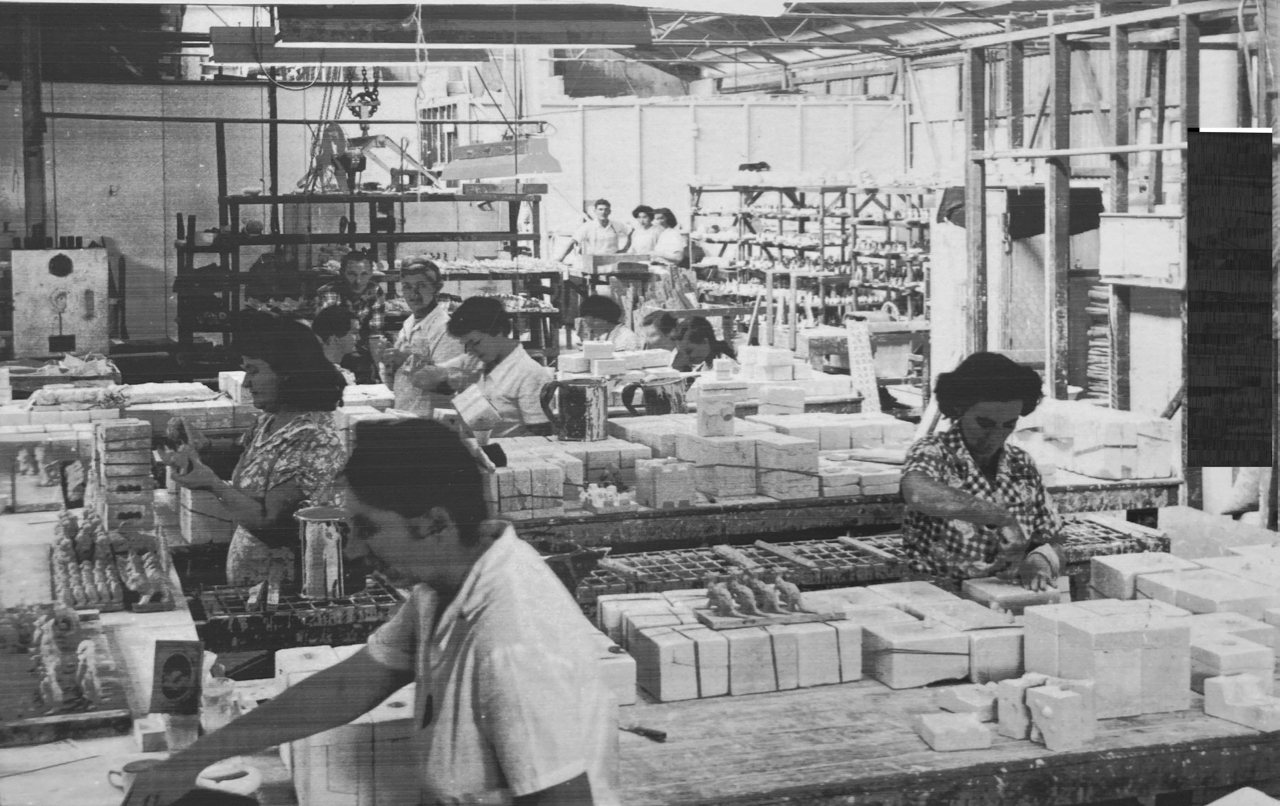
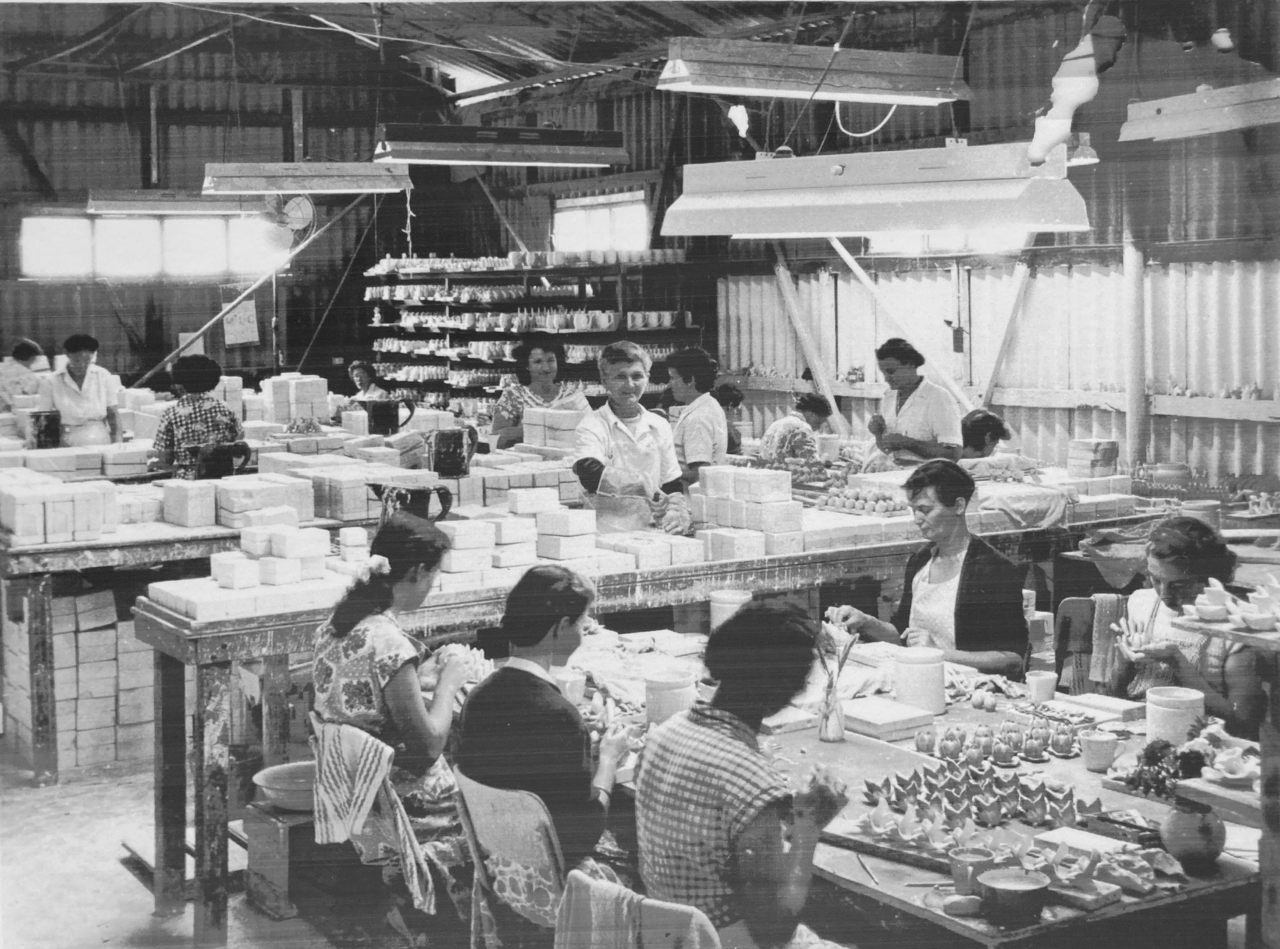
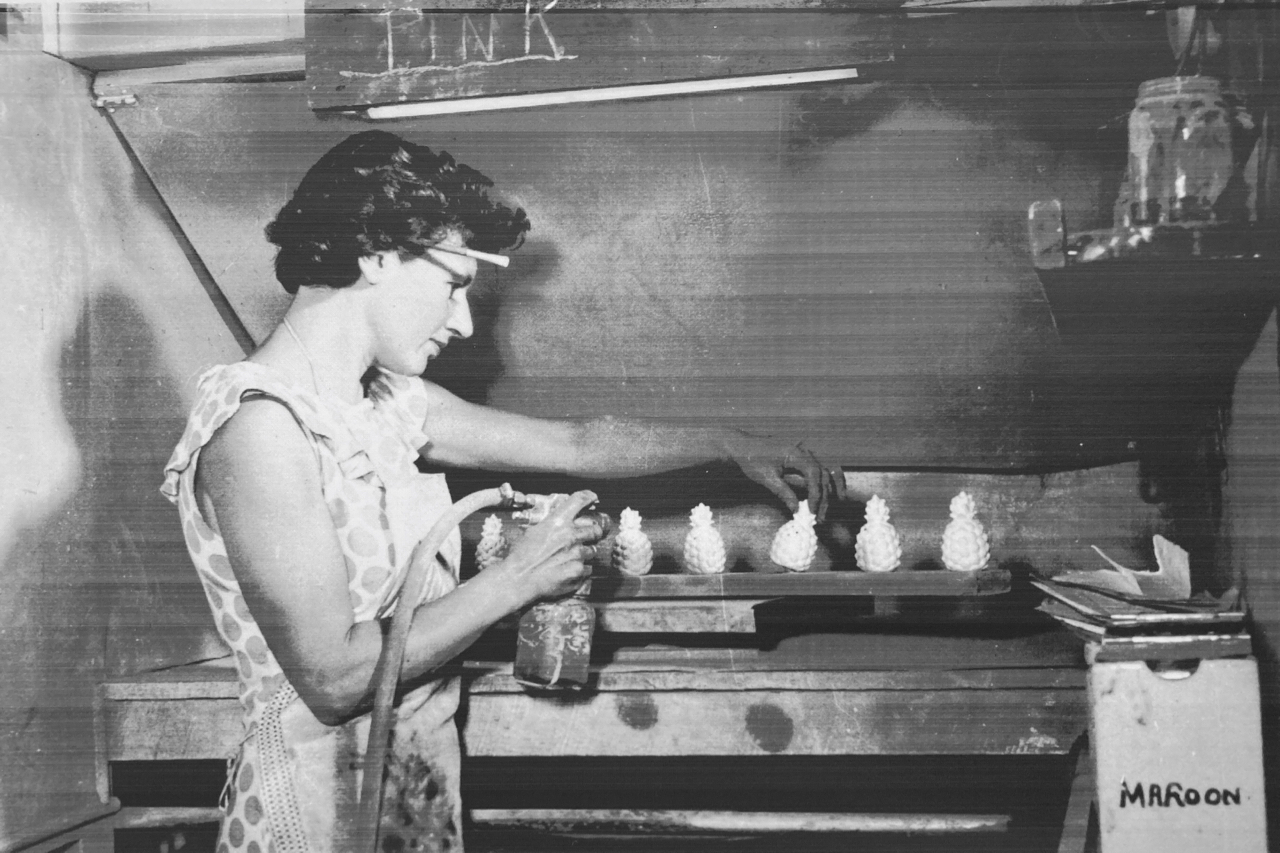
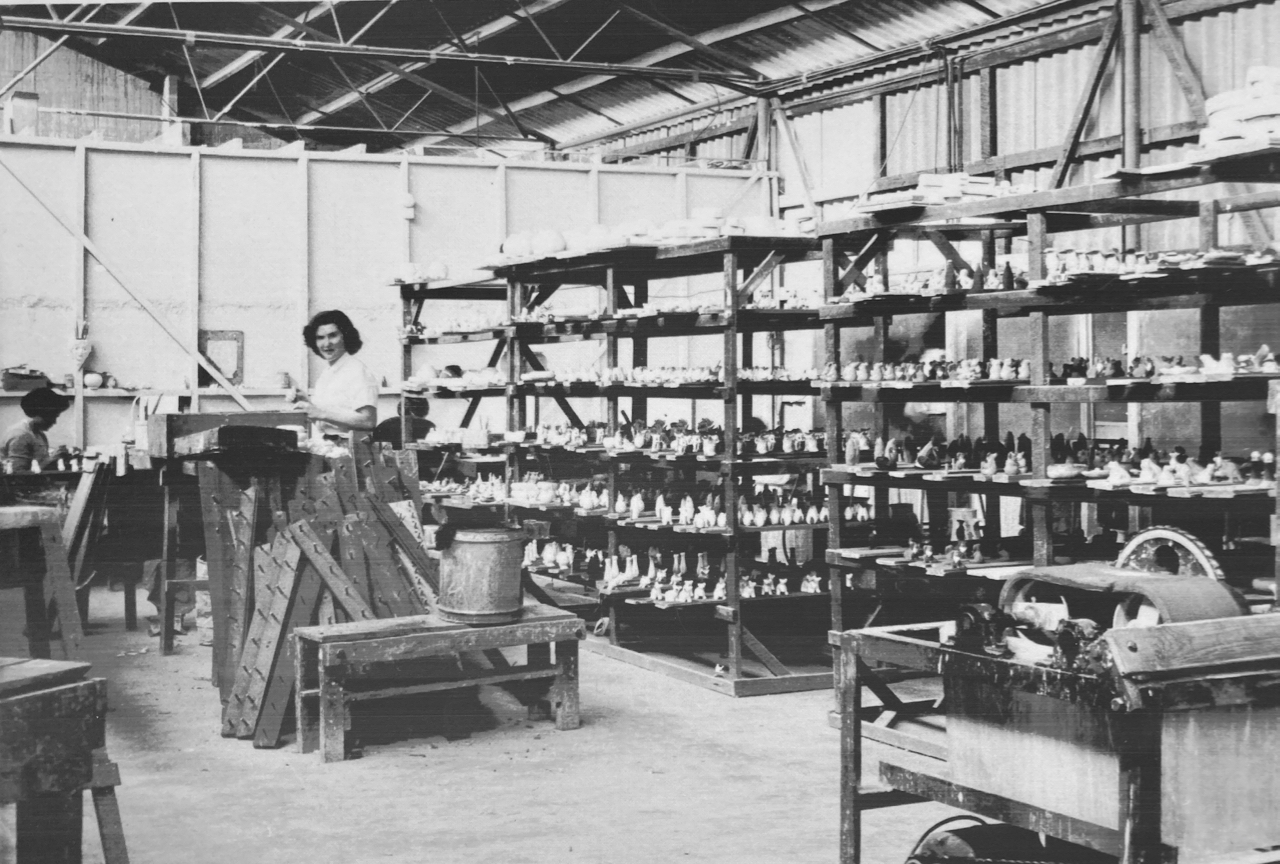
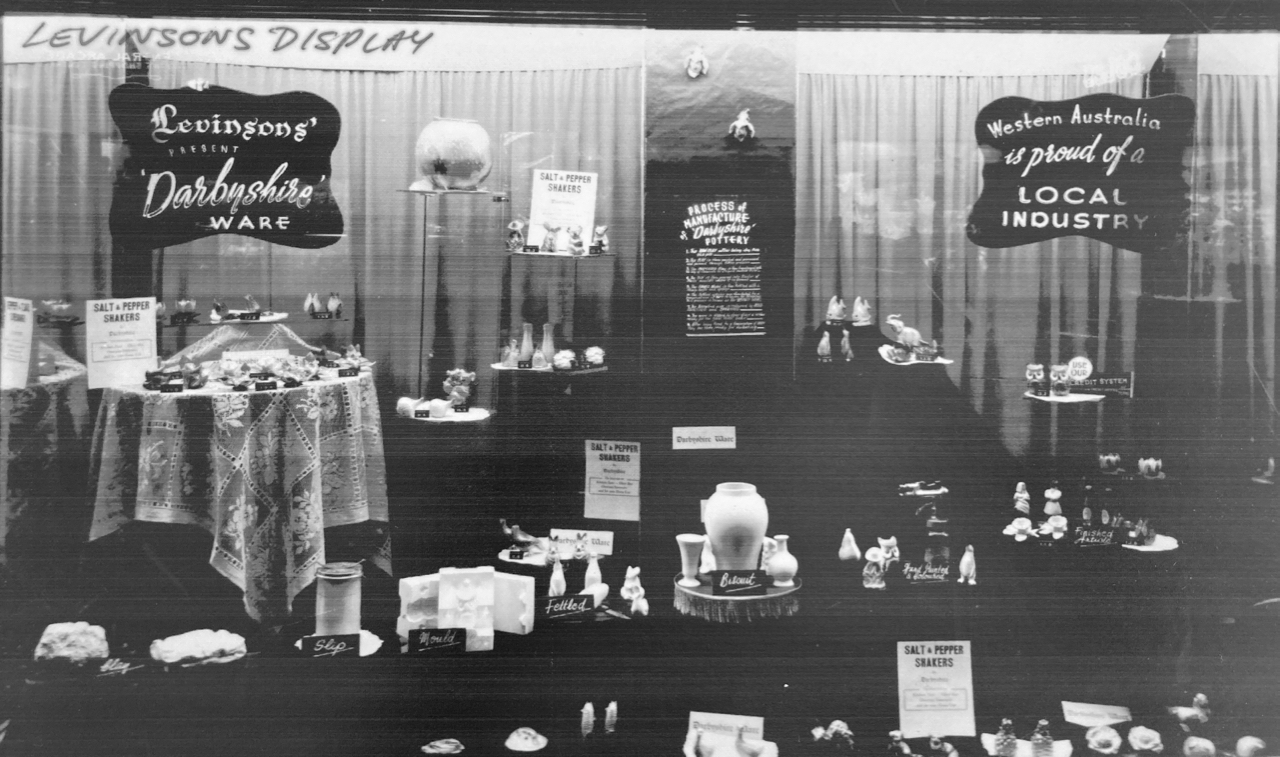
They had three large kilns to handle the increased production. All up it took two weeks for the process; from the making of the clay slip, pouring into moulds, fettling the moulded pieces, drying, first firing (9 hrs), spray painting, hand painting, dipping in the secret glaze and the last firing (16 hours) to produce the finished piece.
At the factory they produced over 150 different items which combined aesthetic interests with the reality of the marketplace. As well as ‘functional items’, like the well-known salt and pepper shakers (60 styles of animals, fruit and flowers- taxed at a lower rate) Darbyshire Pottery also produced ‘novelty items’, such as the Urchin Series (designed by Paul Rigby in 1956) and ‘Dr Livingstone and the Cannibal’, and ‘decorative items’ (which were taxed at a higher rate). The pottery was sold throughout Australia and exported to New Zealand and Papua New Guinea.
“MODELLER wanted by Darby shire Pottery, qualified applicant will receive high wages or one with natural ability will be trained.” West Australian 13 Nov 1953, p.47
Darbyshire Pottery hired many ex-service personnel and professionally trained Eastern European migrants that had recently landed in Perth, after fleeing war torn countries. One of these was 43-year-old Ukrainian Alexander (Shura) Beresowsky, who had graduated from an art academy in Kiev, Ukraine, when he was 29. In 1951, while working at DP, he exhibited with Howard Taylor at Newspaper House. (ref)
Jean remained in the position of production manager and her personal interest was in the more ‘artistic lines’ such as vases and figurines. The complex Aboriginal figurines (requiring between 12- 36 pieces to each mould) were first modelled by talented artists Bruno Guigliarelli (Italian) and Alexander Berezowski in 1953. (ref) Bruno came to Australia in 1949 and worked as a stonemason by day and a modeller for Darbyshire Pottery four nights a week from 1952-1958.
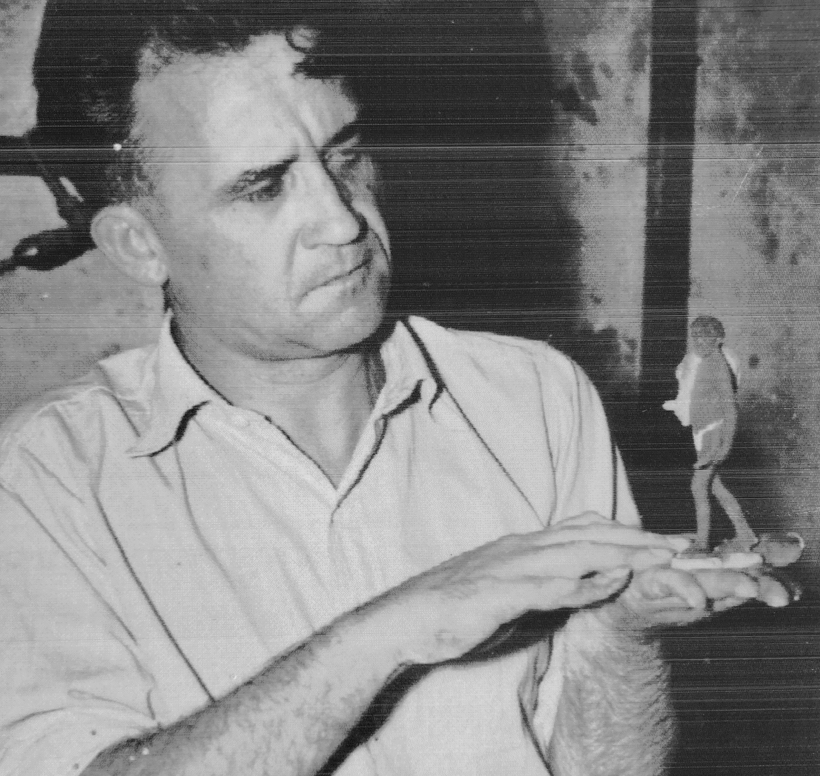
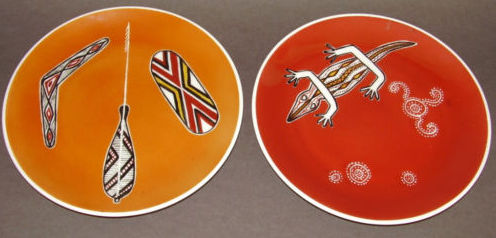
Vaclovas Rataiskis-Ratas, a well-known Lithuanian artist and curator, arrived in Perth in 1949- and contributed distinctive graphic designs to the DP ‘Aboriginal-themed’ plates and worked stacking or ‘building in’ the kilns, a crucial job.
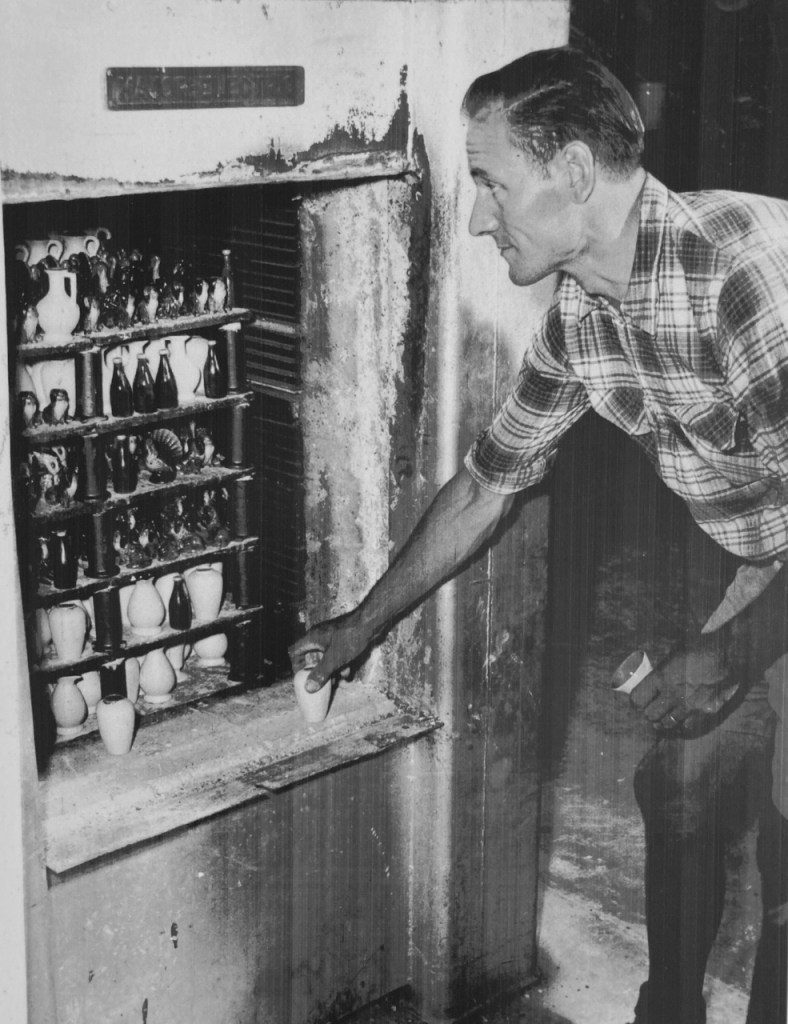
Western Mail, 27 July 1950
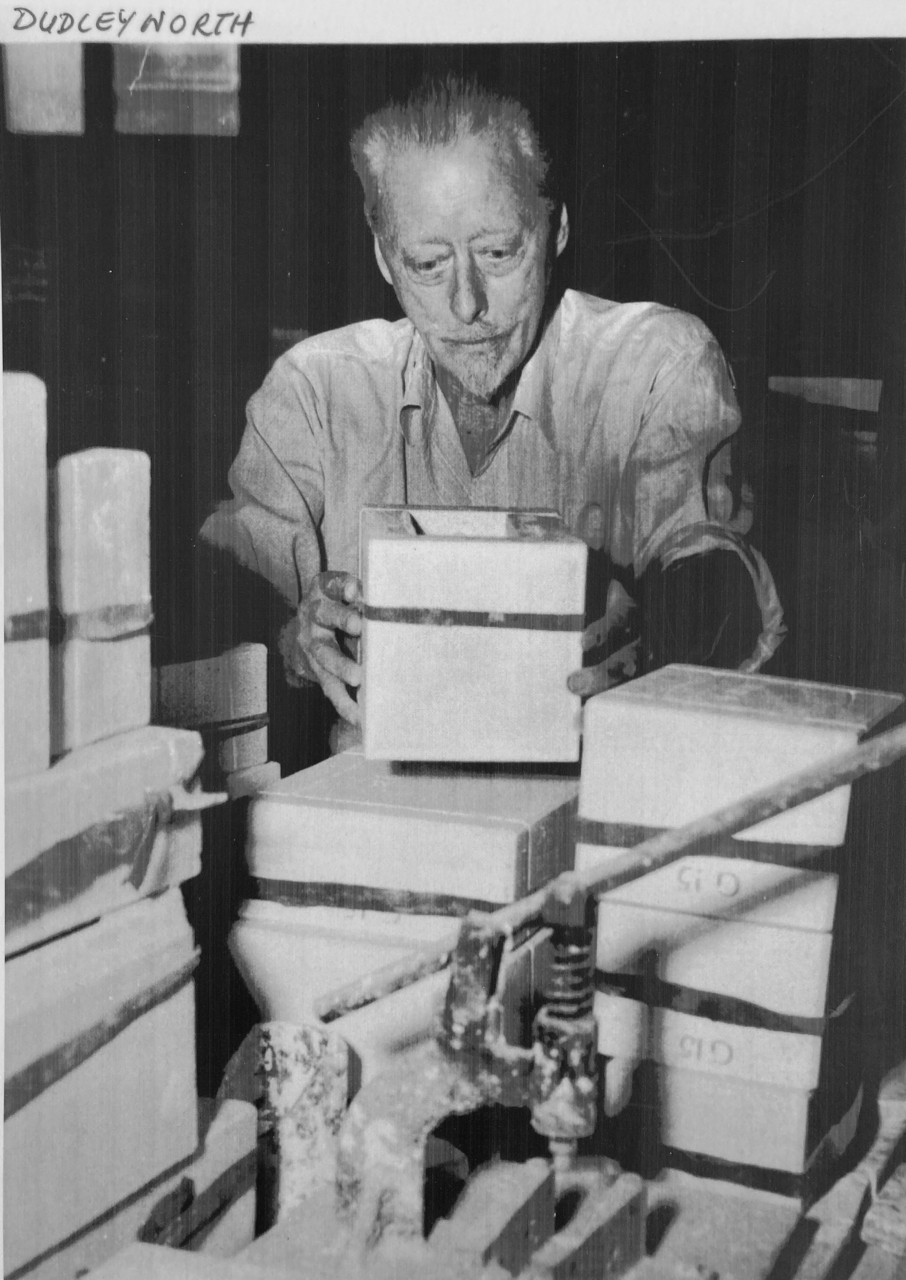
Other staff included Boris Cunovas (Russian) a ballet dancer, and Herta Rosa Ostaffi (1922-2019) & Stephan Ostaffi (decorator & kiln stacker)(Czech Republic), who all also worked for Wembley Ware; George E. ‘Dudley’ North (1893-1969-mouldmaker), Pia Shrikker (Dutch-ceramic chemist), Frank ‘Wickie’ Duyker, Frank Over, Frank Halsdane (see info below), Myrtle Anderson, Mr Gough, Christine Wintle, Olive Smith, Lorraine Wishart, Cliff Tomlinson, Joy Rettig aka Joyce Constance Taylor (1922–2006) and Glynis Enid Jones (became Michell Balle/’Bobby’). It is also thought that in 1955 -Elizabeth Patricia ‘Pat’ Elvins (1922-2011) worked as a designer of animal figurines for Darbyshire Pottery in Perth, before relocating to Alice Springs. (ref) By 1954 DP employed 64 workers.
From 1953-1957 Jean and Bill lived a very happy and social life at their flat at 12 Bishops Grove, St Georges Tce, Perth. On 18 April 1954 Stirling and Tony celebrated their joint 21st birthdays together, hosted by Bill and Jean at the Shaftesbury Hotel in Perth (Sunday Times, 18 April 1954 p 17).
In 1954 the company expanded, both in capital, turnover and by expanding the warehouse from 3,000 to 6,000 square metres. They also fought Eastern States companies copying their figurines.
NOTICE IS HEREBY GIVEN that DARBYSHIRE WARE POTTERY PTY. LTD.” has by a Special Resolution of the Company changed its name to “DARBYSHIRE POTTERY PTY. LTD.” 22nd day of April 1954. A. W. L. DARBYSHIRE, The West Australian, 8 May 1954- Page 22.
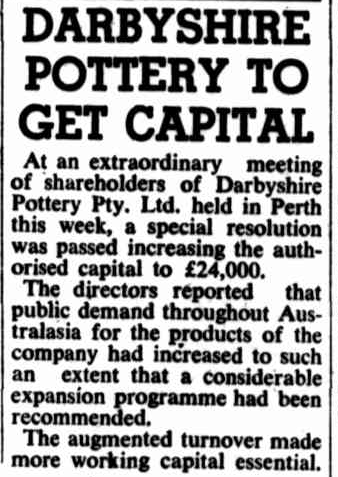
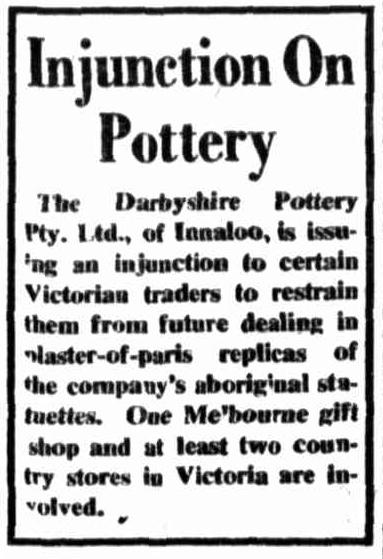
In 1954 the company was confidently renamed Darbyshire Pottery Pty Ltd. They produced many ceramic objects for the 1956 Olympic Games in Melbourne.
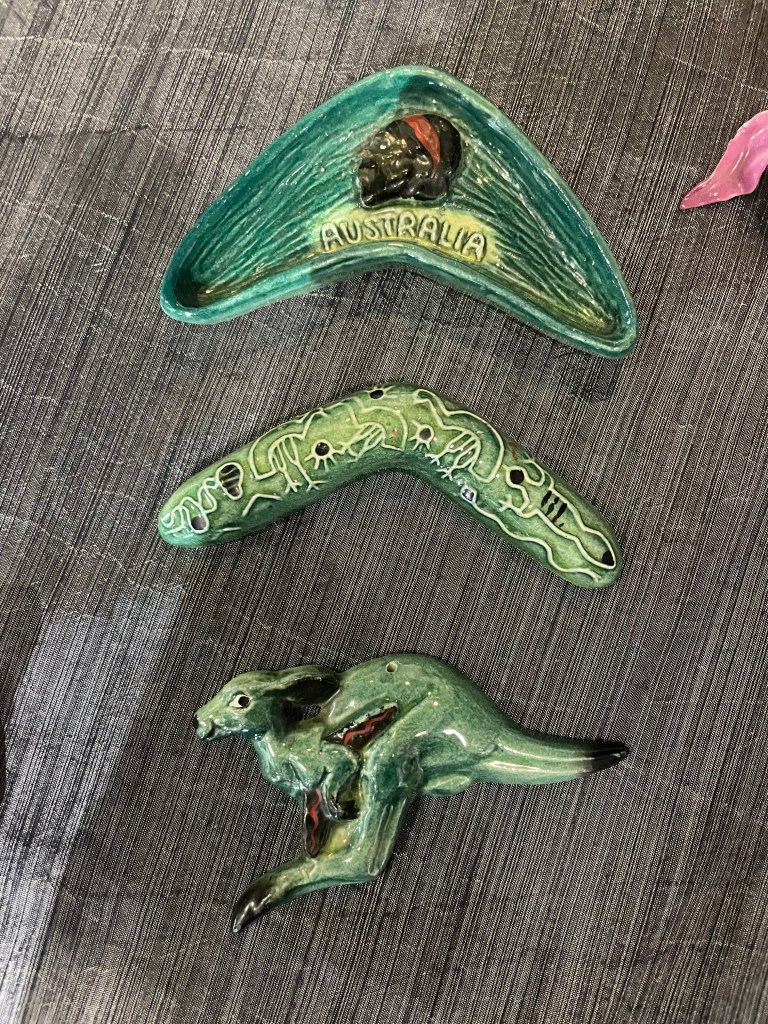
However by 1958 Darbyshire Pottery went into receivership. The closure was forced upon it by a Government sales tax policies which allowed the local market to be flooded by cheaper products from overseas, mainly Japan. Wembley Ware survived by going to skeleton staff and Jean worked hard to organise that some Darbyshire employees (Glynis Enid Jones (became Michell Balle/’Bobby’) got jobs there.
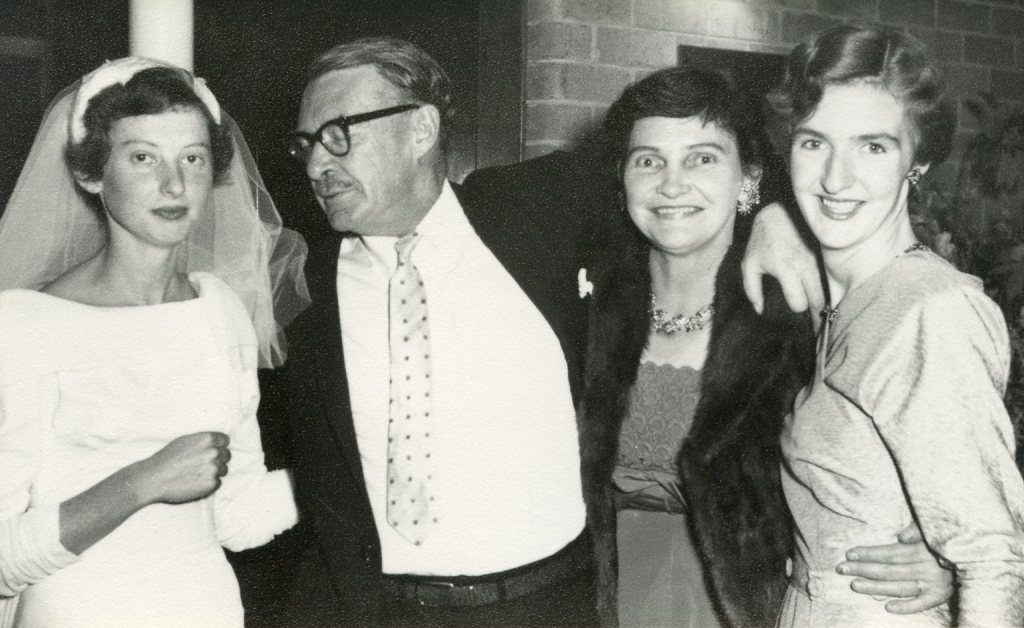
Resiliently, in 1958, Bill and Jean became Proprietors of the Widgiemooltha Hotel, and in 1959, the Boyup Brook Hotel. In July 1961 they moved to Angaston, South Australia to run the Wanera Guesthouse‚ which provided vital accommodation for the Adelaide contractors and workers building the local cement works- and tourists to the Barossa.
Bill Darbyshire died on 25 January 1964 in Angaston, South Australia, at the age of 60. They had been married 22 years.
Jean continued Wanera, and later, with the help of partner Harry Sedgwick, a carpenter, who lived with her.
7 July 1993 Jean had a last art exhibition, at the Bethany Art Gallery, Angaston, SA.
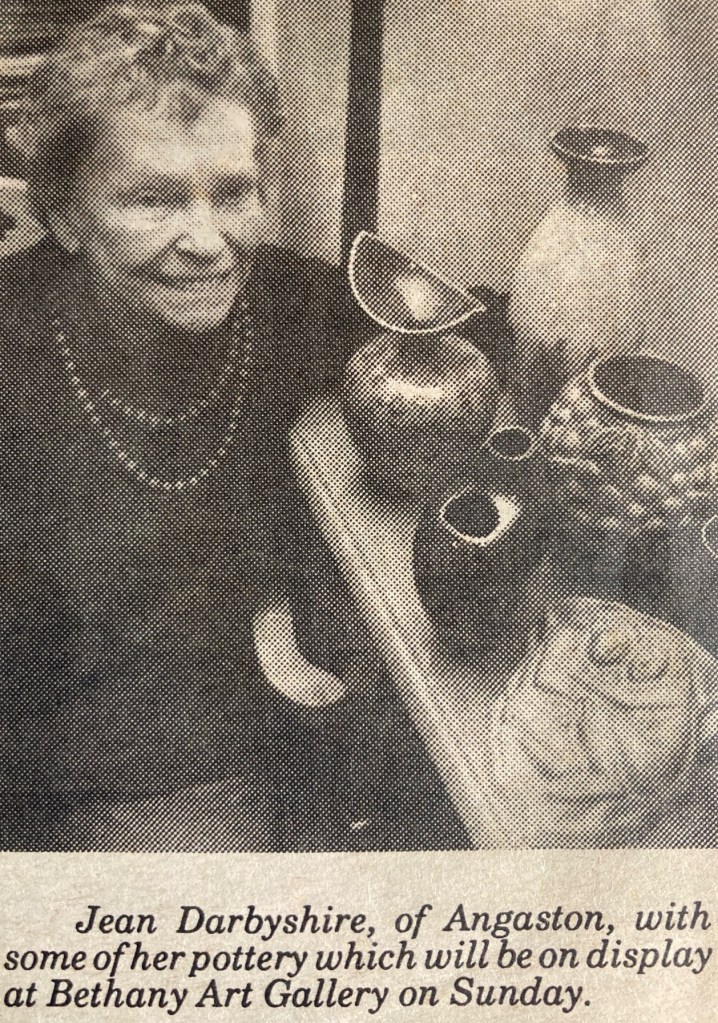
In 1995 Harry Sedgwick died and Jean had an operation from which she never really recovered.
Jean died 27 March 1996 at home in Angaston, South Australia, aged 90.
Bill’s son Tony and Jeans son Stirling both worked in the DP factory as teenagers, and remained close all their life.
After her death Stirling and Judy Shaw tried to find a place for Jean’s legacy. They first offered donations to the Art Gallery of WA, who were not initially interested. They then offered a collection to the Shepparton Art Gallery who took a major donation in 1999/2000. In 2001 Stirling again approached the AGWA and the Gallery accepted a range of Darbyshire Wares in 2004. The WA Museum also holds some unfired ceramic vases, acquired in 2008.
Stirling Shaw died in 2013 and Tony Darbyshire died in 2019.
References: Melissa Harpley, ‘Darbyshire ceramics’, Australiana, Feb 2005, p 12-13, Research Paper by Nanette Henderson and Beth Allan, 2011, Obituary read at Jeans funeral (pastor Fred Kummerow), 1996, ‘From the maker to the Shaker’, E.P.J., Western Mail, 27 July 1950, p 19, Hyde, Dylan. Art Was Their Weapon. Fremantle Press, 2019.
Written by Jo Darbyshire May 2013
some photos contributed by Jenny Shaw
***********************************************************************
Photos below: Darbyshire Pottery factory, Odin Rd, Osborne Park c1953 (click to enlarge) unknown photographer. George E. Dudley North (1893-1960) had served with the 11th Australian Field Baking Co in WW ll and was both a friend and a worker at DP.
Darbyshire Ware in Levinsons Shop window display, Perth c 1952? Their pieces were also sold by Boan’s and Ahearns, locally in WA.
The Paul Rigby urchins were made by Darbyshire Pottery in 1956. They were based on the street urchin that appeared in the back of the cartoons drawn by Daily News cartoonist Paul Rigby. About 10,000 of these ceramic urchins were made to order by DP- and were painted in the colours of the 8 WAFL clubs and other amateur clubs. Large orders were taken to supply souvenirs for the Olympic Games held in Melbourne. They are now highly sought after. See production photo below, 1956 showing some of the urchins.
The portraits at the top of this page were painted by Leon Hogan, a Victorian artist, who after being released from the RAAF in 1944, worked briefly in Perth, post war, and exhibited oil paintings at Boans Art Gallery in 1944 (ref) and Newspaper House Art Gallery in 1946 (Dec 16 – Dec 24) (ref). It was at this exhibition that he showed his portrait of Jean: “His portraits give convincing proof of his ability to search out the personality of his sitters, and of his power to use his medium in a straight-forward and workmanlike manner. We seldom see work of such high quality in Perth… The smaller heads, one of “Jean” especially, are soundly painted, and “Jean” is full of vitality and rich colour…” ( from a review in the West Australian, 18 December 1946, page 12)
In 1946 Hogan undertook a 5 month, 3500-mile journey through the northwest of WA in a converted army scout car, in search of unusual scenes to paint.(ref) In 1947 Hogan made waves for painting a very nude ‘Zandra’, a painting which was bought, and hung at the Court Hotel, Perth.(ref) He returned to the Eastern States soon after.
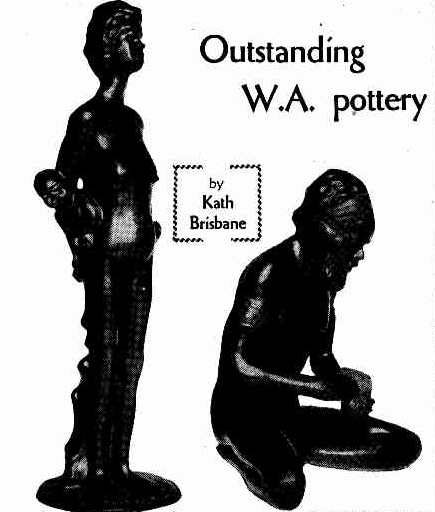
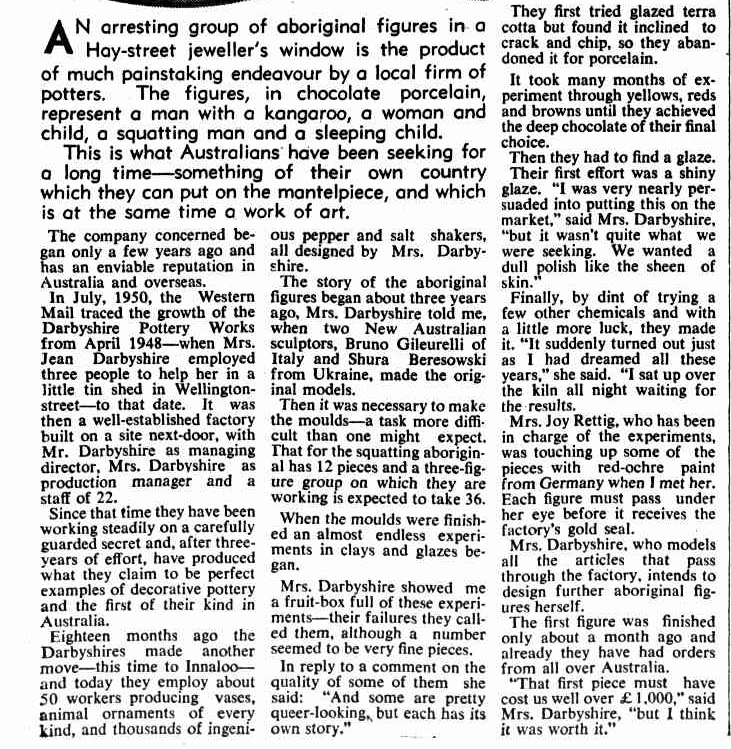
Western Mail, 5 Nov 1953, p13
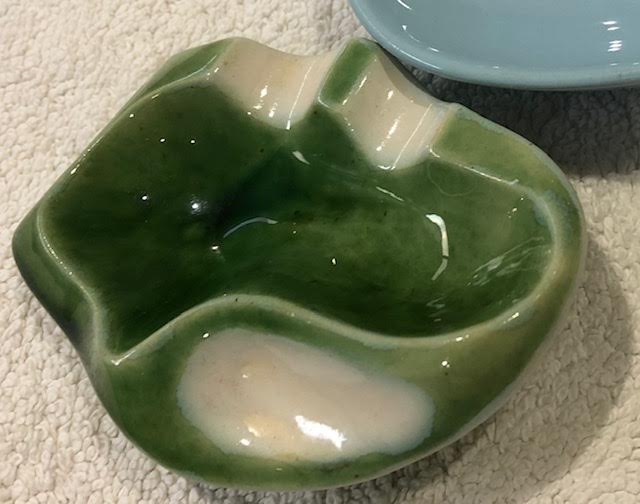
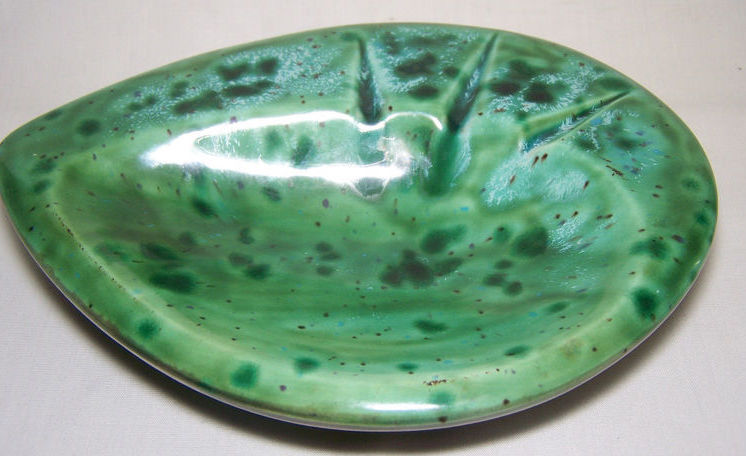
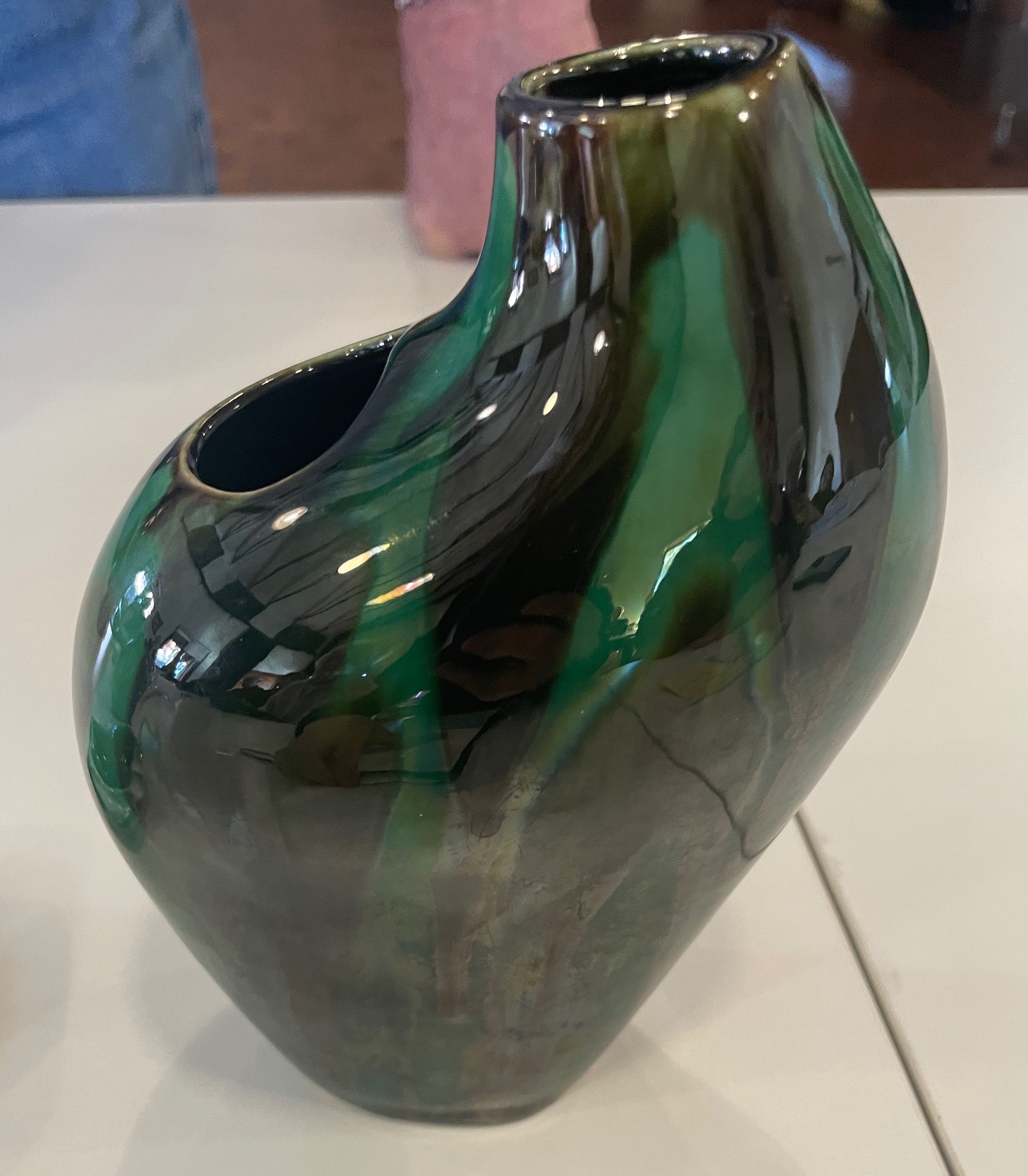
Frank Halsdane was a commercial artist who worked with DP, modeling animals (Shag on a rock is his) and abstract vases. Halsdane continued to produce pieces (ashtrays-see below-with distinctive green glaze) at the factory in 1959, after Jean and Bill left.
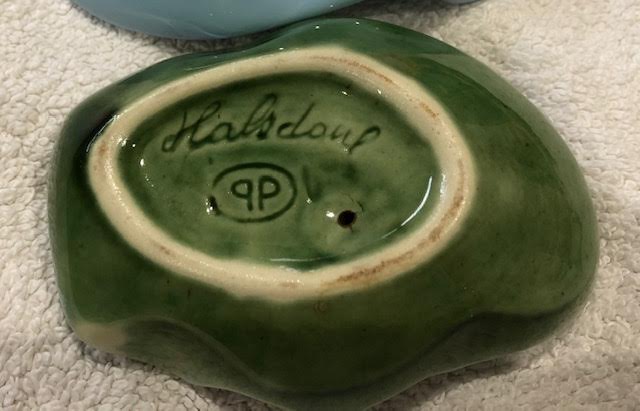
 Darbyshire Pottery Society